
Categories
Real Estate, Selling HomePublished August 17, 2026
Pool or No Pool? That is the Question.

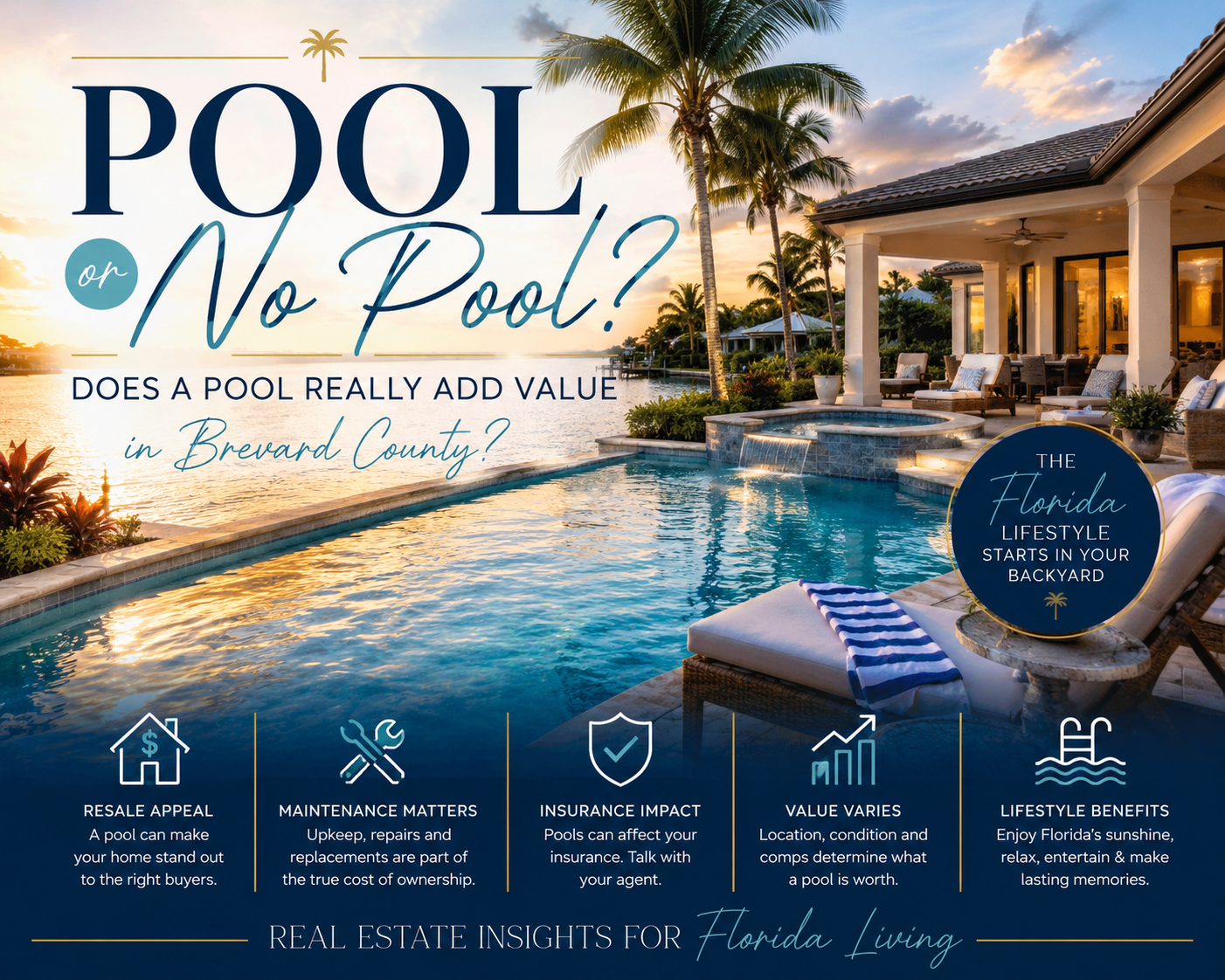
Pool or No Pool? Does a Pool Really Add Value in Brevard County?
If you've spent any time on the Space Coast this summer, you already know the appeal of a backyard pool. Between the humidity, the kids home from school, and the fact that we're basically surrounded by water anyway, a pool feels like a natural fit for Brevard living. But as a REALTOR®, I get asked: "Amy, if I put in a pool, will I actually get that money back when I sell?"
The honest answer is: it depends. And the last year or two, the math has shifted a bit because of the past rise in insurance costs and new tariffs on building materials. Let's break it down.
The Resale Appeal: Yes, Pools Add Value in Florida
Here's the good news first. Florida is one of the small handful of states, alongside Arizona, Texas, California, and Nevada, where pools reliably add resale value rather than just sitting there as a personal luxury. Multiple national real estate data sources put the typical value bump for a well-maintained inground pool in a warm climate like ours at 5% to 15% of home value, with above-ground pools rarely moving the needle at appraisal time.
A few things matter a lot for how much value your pool actually delivers:
- Neighborhood norms. If most homes in your subdivision have pools, buyers may expect one and a home without one can feel like it's missing something. In a neighborhood where pools are rare, yours can be a genuine differentiator.
- Condition and design. A dated, cracked, or poorly maintained pool can actually hurt your resale value rather than help it. Buyers see a tired pool and start doing maintenance math in their heads before they've even made an offer.
- Type of pool. Inground pools (especially screened) consistently outperform above-ground pools, which most appraisers treat as personal property with little to no resale credit.
The ROI Reality Check
Here's the part sellers are sometimes surprised by: even in pool-friendly Florida, most homeowners do not fully recoup the cost of installing a pool. Typical return on investment for an inground pool lands somewhere around 30% (older) to 60% (newer) of the installation cost. So if you spend $70,000 on a new pool, you could see $45,000 of that reflected back in your resale price if you sell within a few years, the rest is essentially the price of enjoying it while you live there. That's not a reason to skip the pool. It just means the decision should be driven primarily by lifestyle, not by treating it as a guaranteed investment return.
The Cost Side: Building a Pool Is More Expensive in 2026
If you're weighing a new pool install this year, it's worth knowing that construction costs have climbed. A standard inground pool in Florida now typically runs $45,000 to $100,000, with custom builds easily topping $150,000. Two forces are driving that upward:
- Tariffs on materials. Section 232 tariffs on imported steel and aluminum. key components in pool rebar, structural framing, pumps, and equipment, have pushed those metals up as much as 50% in some categories, with derivative products around 25%. Softwood lumber used for decking and framing carries its own tariff as well. Pool industry groups report that nearly half of pool builders expect these costs to keep nudging prices higher through the rest of 2026.
- Labor shortages. The broader Florida construction industry is short hundreds of thousands of workers nationally, which is stretching timelines and pushing up bids and pool installers are competing for the same skilled trades as home builders.
The Ongoing Cost Nobody Talks About Enough: Insurance
This is the piece that's changed the most for Florida homeowners lately, and it's worth factoring into any pool decision.
Florida remains the most expensive state in the country for homeowners insurance, though rate growth has started to slow thanks to 2022–2023 tort reform legislation and new carriers re-entering the market. Locally, homeowners insured through Citizens Property Insurance (the state's insurer of last resort) in Brevard County are paying an average of roughly $2,348 a year, with thousands of Brevard homes currently on that plan because private carriers have pulled back.
A pool doesn't automatically blow up your premium the way a new roof issue might, but it does typically increase your liability exposure. Insurers view pools as an "attractive nuisance" that raises the risk of an injury claim. Depending on your carrier, that can mean:
- A modest bump in your liability coverage premium
- A requirement (or strong recommendation) for a code-compliant safety fence, self-latching gate, or pool alarm
- A nudge toward adding an umbrella liability policy for extra protection, which is relatively inexpensive but is one more line item to budget for
None of this is a reason to avoid a pool, but it's a real cost that should be part of your "should I add a pool" math, right alongside the sticker price.
So, Pool or No Pool?
In Brevard County, a well-built, well-maintained inground pool genuinely can boost your home's resale appeal and help it stand out, especially in neighborhoods where pools are common or where your lot backs up to nothing but Florida sunshine. But it's rarely a dollar-for-dollar investment, construction costs are up due to tariffs on steel, aluminum, and lumber, and ongoing insurance and liability costs deserve a real look before you sign a contract.
My advice to clients: think of a pool as a lifestyle upgrade first and a value-add second. If you're going to enjoy years of Saturday afternoons in it, that's worth something no spreadsheet fully captures. If you're installing one purely to flip a house in twelve months, run the numbers with your Realtor and insurance agent first.
If you're weighing this decision for your own home, whether you're thinking about adding a pool, buying a home that already has one, or wondering how it'll affect your next sale, I'm always happy to help you think it through. Reach out anytime.
Sources: Space Coast Association of REALTORS® monthly housing statistics; Insurify 2026 Insuring the American Homeowner Report; Citizens Property Insurance Corporation, Policies in Force by County (April 2026); Momentum Realty Brevard County Housing Market Scorecard (2026); Pool & Hot Tub Alliance federal tariff policy tracker; Associated Builders and Contractors / Construction Dive 2026 industry outlook; Opendoor, Swimply, and Thursday Pools 2026 pool cost and resale value guides.
This article is for general informational purposes and reflects data available as of August 2026. Insurance premiums, construction costs, and market values fluctuate; talk with your REALTOR®, insurance agent, and a licensed pool contractor for figures specific to your property.
Amy L Lewis
| Amy L Lewis | Keller Williams Realty Brevard
or another way